.png)
Multiplex Immunofluorescence (IF): A Brief Guide for Tissue Research
- Eghosa Arovo

- Feb 18
- 4 min read
Multiplex IF lets you visualise multiple proteins in one tissue section — here’s how it works and when to use it.

Introduction
As histology research moves toward higher-content, spatially resolved analysis, multiplex immunofluorescence (IF) has become an important technique for detecting multiple proteins in a single tissue section.
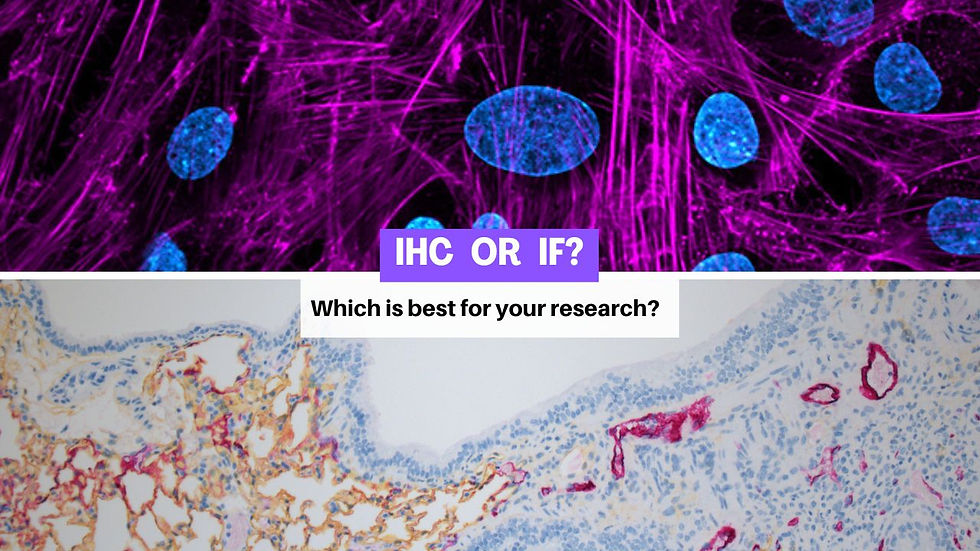
Like chromogenic immunohistochemistry (IHC), IF uses antibodies to bind specific antigens. The key difference is that IF visualises those antibodies using fluorescent dyes (fluorophores) instead of coloured chromogens.
In this short blog, we explain what multiplex IF is, what it’s used for, and how it fits into modern tissue and cancer research.
What is multiplex immunofluorescence?
Multiplex IF is a form of immunofluorescence in which several antibodies are applied to the same tissue section, each detected using a different fluorophore.
Each fluorophore emits light at a specific wavelength when excited under a fluorescence microscope or scanner. This allows multiple protein targets to be visualised simultaneously using different colours such as green, red, far-red, and near-infrared.(Abcam, 2023)
In practice, multiplex IF can detect:
3–5 markers in standard workflows
10+ markers using cyclic or tyramide-based amplification methods
All while preserving tissue architecture and spatial relationships between cell types.
Why do researchers use multiplex IF?
Multiplex IF is widely used in:
Cancer research — mapping tumour cells, immune cells, and stromal markers
Immunology — profiling immune infiltration and checkpoint expression
Spatial biology — studying how different cell populations interact
Drug development — evaluating biomarker co-expression and response
Its main strength is the ability to study co-expression and spatial relationships between many markers at once — something that is difficult to achieve using serial tissue sections.(Fridman et al., 2012)
How multiplex IF works (in simple terms)
A typical multiplex IF workflow involves:
Applying a primary antibody against the first target
Detecting it with a fluorophore-labelled secondary antibody
Imaging the slide
Either:
Adding more antibodies sequentially, or
Removing antibodies and repeating staining cycles (cyclic IF)
Each round adds another marker to the same tissue section. The final images are digitally aligned and merged to generate a multi-marker spatial map.(Abcam, 2023)
Strengths of multiplex IF
Multiplex IF offers several clear advantages:
High multiplexing capacityMore markers can be detected per slide compared with chromogenic IHC.
High sensitivityFluorophores can detect low-abundance proteins more easily than chromogens.
Strong spatial resolutionIdeal for studying tumour microenvironments and immune niches.
Compatibility with spatial biology and AI workflowsMultiplex IF data integrates well with advanced image analysis tools.
Practical limitations to be aware of
Despite its strengths, multiplex IF also has practical drawbacks:
Signal fading (photobleaching)Fluorescent signals degrade over time and with repeated imaging.
Higher technical complexityRequires specialised microscopes, scanners, and image processing software.
Higher costFluorophores, amplification kits, and cyclic workflows are expensive.
Autofluorescence issuesMany tissues (especially FFPE) produce background fluorescence that can obscure true signal.(Pendergraft & Preston, 2015)
For these reasons, multiplex IF is often reserved for high-end exploratory or spatial biology studies, rather than routine histology workflows.
Multiplex IF vs chromogenic multiplex IHC
While multiplex IF offers higher marker capacity, chromogenic multiplex IHC remains the more practical choice for many research projects.
Chromogenic multiplex IHC offers:
Permanent, archive-ready slides
Brightfield imaging compatibility
Lower cost and simpler workflows
Excellent reproducibility
Visual co-localisation via colour mixing (“1 + 1 = 3”)
For most cancer and tissue research applications, chromogenic multiplex delivers the best balance of complexity, clarity, and scalability.
How LabNexus supports multiplex histology research
At LabNexus, we specialise in research-only histology services and focus primarily on high-quality chromogenic IHC and multiplex IHC.
We offer:
Single-plex IHC using DAB or bright chromogens
Multiplex chromogenic IHC(Red, Purple, Teal, Blue, Green, Yellow, DAB, Silver)
Tissue processing, embedding, and sectioning
Slide scanning for digital analysis
Optional TMA construction for cohort studies
While we can advise on IF-based workflows, our core strength is delivering robust, archive-ready chromogenic IHC using state-of-the-art automated staining platforms.
Please note: LabNexus provides histology services for research purposes only. We do not process diagnostic samples.
Conclusion
Multiplex immunofluorescence is a powerful technique for visualising many proteins at once and exploring spatial biology in complex tissues.
It is best suited for:
High-multiplex discovery studies
Immune profiling
Spatial biology and systems-level tissue analysis
For most routine, translational, and publication-focused histology projects, however, chromogenic IHC and chromogenic multiplex remain the more practical and cost-effective choice.
Whether you’re exploring multiplex IF conceptually or planning a chromogenic multiplex project, LabNexus is here to support your tissue research with high-standard histology services.
References
IF Multiplex section from Lunaphore: https://chatgpt.com/c/684aba77-b8dc-8010-85d0-fc191bd78657
Abcam. Immunofluorescence (IF) staining overview.https://www.abcam.com/en-us/knowledge-center/immunofluorescence/if-staining
Abcam. Multiplex immunohistochemistry (mIHC): technical overview.https://www.abcam.com/en-us/knowledge-center/immunohistochemistry/multiplex-immunohistochemistry-mihc
Fridman, W.H. et al. (2012). The immune contexture in human tumours: impact on clinical outcome. Nature Reviews Cancer, 12, 298–306.
Pendergraft, S.S., & Preston, G.A. (2015). Methods in immunofluorescence. Methods in Molecular Biology, 1274, 3–16.
Bancroft, J.D., & Gamble, M. (2020). Theory and Practice of Histological Techniques (8th ed.). Elsevier.

Comments